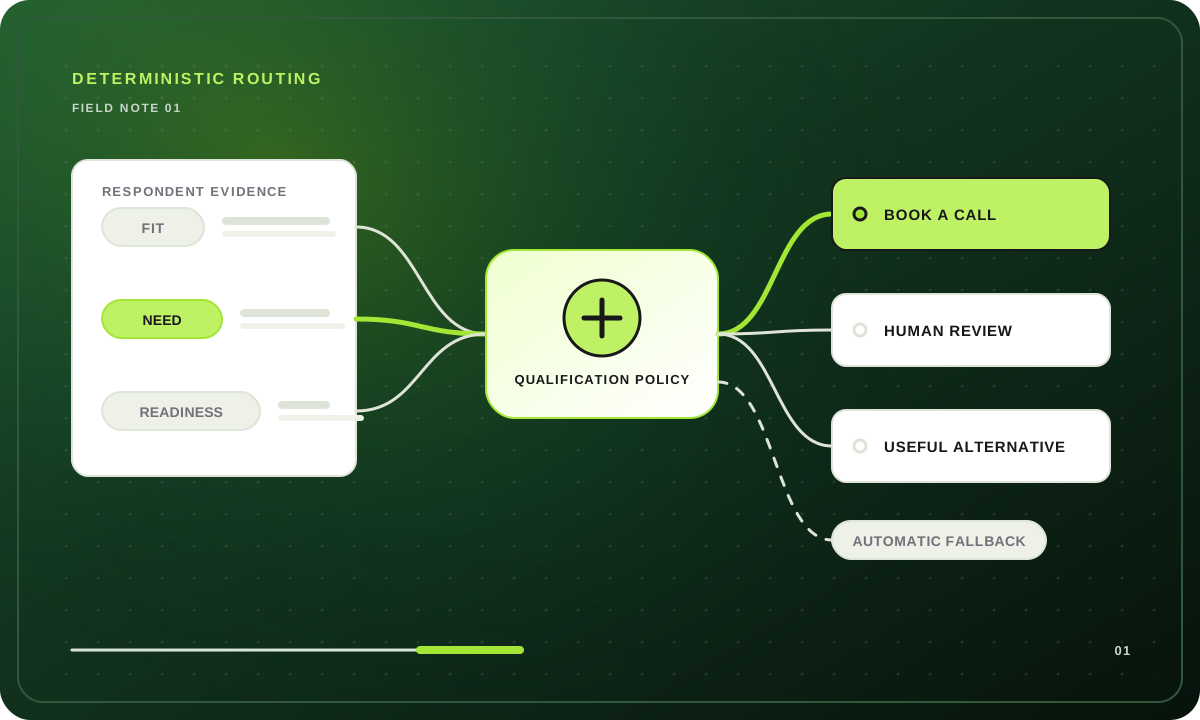
AI lead qualification forms work best when they help apply a written decision policy to useful context. They work poorly when “AI-powered” replaces a clear definition of fit.
The practical design is a hybrid: use deterministic questions and branches for facts you can state precisely, use AI for answers that need interpretation, and keep an automatic fallback route for the moments when AI cannot run. Think of AI as an interpreter, not a tiny oracle hiding behind the Submit button.
What an AI qualification form actually does
A qualification form collects the evidence needed to choose a next step. That evidence usually covers four areas:
| Area | Useful evidence | Better handled by |
|---|---|---|
| Fit | audience, geography, project type | deterministic choices |
| Need | problem, desired outcome, current approach | open text with optional AI |
| Readiness | timeline, priority, internal capacity | choices plus explanation |
| Commercial context | budget range, decision process | clear choices or open text |
AI is most useful for interpreting open text across several answers. For example, “We need this next month because our current intake is losing enterprise requests” contains urgency, a problem, and an implied consequence. A rigid score can miss that context.
AI should not be asked to invent missing facts. If a respondent never gives a budget, the evaluation should say the budget is unknown rather than guessing.
Start with a written qualification policy
Before opening a form builder, write three short lists:
- Conditions that clearly qualify someone.
- Conditions that clearly make the request a poor fit.
- Signals that require a human review.
Keep the language observable. “Good lead” is not an instruction. “A service business with a defined project, an owner for the work, and a start date inside 90 days” is much closer.
A useful AI instruction names the desired outcome and the disqualifiers. It also tells the model how to handle uncertainty. The result should be a routing decision with a concise reason, not an imaginary probability score.
Keep the route deterministic
The route after an evaluation should be explicit:
- Qualified respondents can see a booking link or a specific next-step page.
- Not-yet-ready respondents can receive a useful guide, waitlist, or follow-up promise.
- Out-of-scope respondents can get a clear explanation and an alternative.
- Ambiguous responses can go to manual review.
The saved route should remain under the form owner's control. In Qualyo, the node-and-edge graph determines the path. An AI qualifier evaluates answers at one point in that graph; it does not rebuild the graph.
Every AI-dependent branch also needs a fallback. Choose the least harmful behavior for your workflow. A high-volume inbound form may fall back to “not qualified” and promise review. A support or safety-sensitive intake may fall back to a human-review route.
Ask fewer, higher-value questions
A qualification form is not a discovery call in miniature. Ask only for information that changes routing, preparation, or follow-up.
A strong sequence is:
- Identify the request.
- Understand the desired outcome.
- Ask what makes the issue important now.
- Collect one or two fit constraints.
- Ask for contact details after the form has shown relevance.
Use supporting text for questions that can feel intrusive. Explain why a budget or timeline helps. Offer ranges when an exact figure is unnecessary.
Review the system, not only the model
After launch, review completed routes and the reasons attached to qualification outcomes. Look for three failure modes:
- the policy is too vague;
- the form never collected the needed evidence;
- the fallback sends people to an unhelpful dead end.
Change the questions or the policy before adding more elaborate scoring. The simplest system that produces a useful next step is usually easier to operate.
Frequently asked questions
Can AI qualify leads without fixed rules?
AI can interpret open answers, but it still needs written criteria that define fit, disqualifiers, and uncertainty. Exact facts such as geography, service type, or an unsupported date should stay deterministic.
What should happen when AI qualification is unavailable?
The form should follow an automatic fallback selected before publication. Depending on the workflow, that may send the request to manual review or use a conservative qualified or disqualified route with a clear explanation.
Should AI lead qualification replace manual review?
No. Manual review remains useful for unusual, incomplete, sensitive, or high-value requests. AI should reduce repetitive interpretation, not remove human judgment where the decision needs it.
Build this workflow in Qualyo
Start from a lead qualification template, add your fit and readiness questions, place a qualifier after the relevant answers, and connect both outcomes to deliberate end or router nodes. You can present the same flow as a conversational or classic form.
Free accounts include 50 lifetime AI conversations. Static forms and submissions remain unlimited. If AI allowance or provider availability interrupts a qualifier, Qualyo follows the automatic fallback outcome selected by the form owner.
For audience-specific examples, see the use-case guides or compare the approach with other form builders.
Sources
External references used for this guide. Product details are checked against the current Qualyo implementation.
- Lead qualification: Gauging whether a lead aligns with your offering: HubSpotAccessed August 5, 2026
- Lead qualification for small and medium businesses: TypeformAccessed August 5, 2026