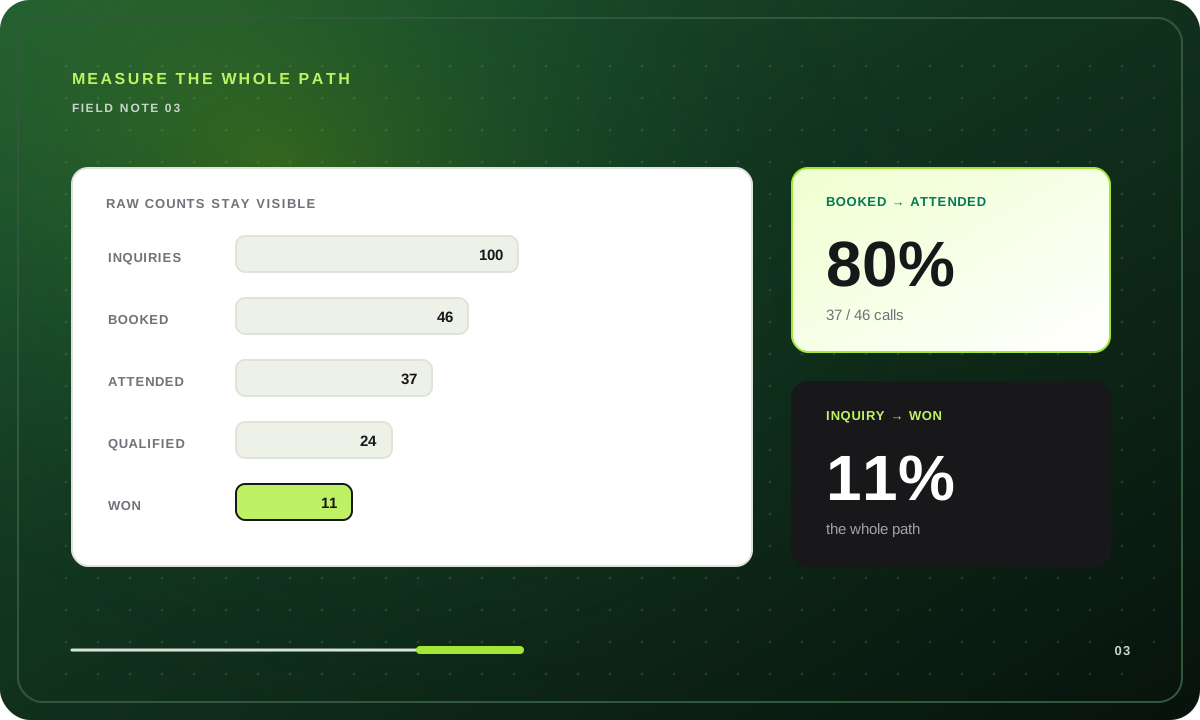
There is no single discovery call conversion rate that explains performance. A team can improve its booking-to-close number by accepting only obvious opportunities, while missing good prospects earlier in the funnel. Another team can book many calls and appear busy while attendance and next-step quality decline.
Measure the path as a set of rates, then investigate where the experience breaks. One blended percentage can make three different problems look like one very confident number.
Define the rate before comparing it
Use a precise numerator and denominator:
| Rate | Formula | What it helps diagnose |
|---|---|---|
| Inquiry-to-booked | booked calls / eligible inquiries | clarity and routing |
| Booked-to-attended | attended calls / booked calls | commitment and reminders |
| Attended-to-qualified | qualified opportunities / attended calls | targeting and criteria |
| Attended-to-next-step | agreed next steps / attended calls | discovery quality |
| Qualified-to-won | customers / qualified opportunities | offer, decision, and follow-up |
| Inquiry-to-won | customers / all valid inquiries | total funnel efficiency |
Do not combine spam, duplicate inquiries, and clearly out-of-scope requests with valid inquiries unless you also report them separately. Do not remove no-shows from the booking denominator; attendance is part of the customer path.
Segment before drawing a conclusion
A blended rate hides important differences. Segment by:
- source or campaign;
- audience and use case;
- offer or service;
- form route;
- self-booked versus manually invited;
- new versus returning prospect;
- time between booking and meeting;
- qualification outcome.
Keep segment definitions stable long enough to learn. Small samples can swing dramatically, so report the raw counts next to every percentage.
Use a decision log, not a vanity dashboard
For each discovery call, record a small set of consistent outcomes:
- attended or no-show;
- qualified, not qualified, or still uncertain;
- primary reason;
- agreed next step;
- next-step date;
- final outcome when known.
The reason is often more actionable than the rate. “No budget” can mean the audience is wrong, the value is unclear, or the budget question came too late. “No urgency” can mean the inquiry path attracts research rather than active projects.
Improve the path one constraint at a time
If inquiry-to-booked is low, review the landing promise and the form. Does the visitor know what happens after submitting? Are you asking for information that does not change the next step?
If booked-to-attended is low, confirm the meeting value, reduce unnecessary delay, send accurate reminders, and make rescheduling easy.
If attended-to-next-step is low, review discovery calls. Did the seller prepare from submitted context? Was there a clear agenda? Did the call end with one explicit action?
If qualified-to-won is low, inspect the offer, stakeholder process, timing, and follow-up. Do not solve a late-stage problem by simply adding more top-of-funnel calls.
Treat pre-qualification as routing, not rejection
Pre-qualification should protect both sides from a pointless meeting while keeping uncertain cases reviewable. Use deterministic rules for facts such as territory or service type. Use human or AI interpretation for nuanced descriptions, and store a reason that can be audited.
The most useful improvement may be a better non-call route: a guide for early-stage prospects, a request for missing information, or a referral for requests you do not serve.
A simple measurement cadence
Review counts weekly and decisions monthly. A weekly view catches operational failures such as a broken booking link. A monthly review gives enough context to adjust questions, criteria, or follow-up.
When you change the form or qualification policy, annotate the date. Otherwise a rate change can be incorrectly attributed to sales execution.
Frequently asked questions
What is a good discovery call conversion rate?
There is no universal benchmark that describes every funnel. Define the numerator, denominator, audience, and stage first, then compare the rate with your own stable baseline and raw counts.
How do you calculate discovery call conversion rate?
Choose one stage pair and divide the later outcome by the earlier eligible count. For example, booked-to-attended is attended calls divided by booked calls, while qualified-to-won is customers divided by qualified opportunities.
Should no-shows count in the conversion path?
Yes. Keep no-shows in the booked-call denominator so attendance problems remain visible. If that stage is weak, use the discovery-call no-show workflow to inspect booking value, delay, reminders, and rescheduling.
Connect measurement to the intake path
Qualyo records form events and route outcomes so you can connect the intake experience to the next step. Start with the AI qualification guide, then map your audience's path from the use-case hub.
Sources
External references used for this guide. Product details are checked against the current Qualyo implementation.
- What is a Discovery Call? Questions and Sample Script: SalesforceAccessed August 5, 2026
- How to mark no-shows for meetings: CalendlyAccessed August 5, 2026