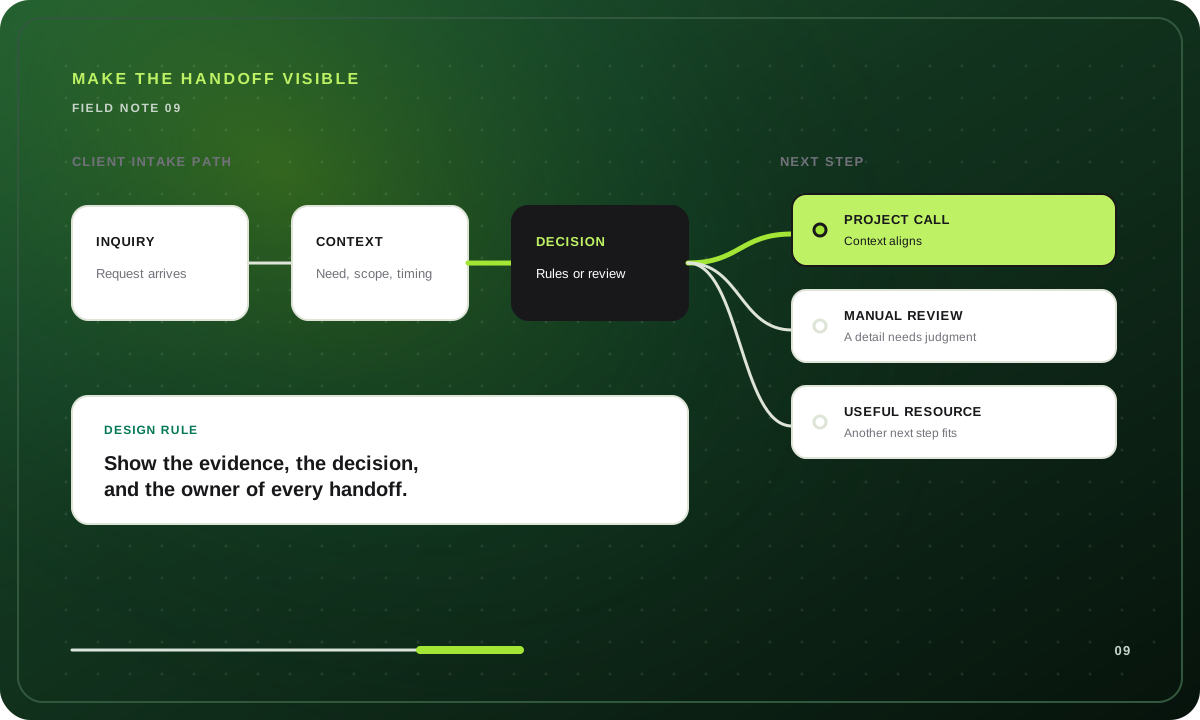
A client intake process flow chart maps what happens between a first inquiry and the next useful step. It should show the questions you ask, the evidence each decision needs, and the endings a person can reach, such as a project call, manual review, a later follow-up, or a helpful alternative. The point is not to automate every judgment. It is to make the process clear for both the prospect and the team handling the request.
Without that map, many teams run an intake process that exists partly in an inbox, partly in someone’s memory, and partly in a message that says “I thought you were handling this.” That is less a process than a scavenger hunt with billable consequences. A flow chart does not make the work disappear. It makes the next decision visible before the handoff gets awkward.
This guide covers pre-acceptance client intake for service businesses. Once a client has agreed to work together, delivery access, assets, kickoff logistics, and working preferences belong in a separate onboarding flow.
What a client intake process flow chart should show
A flow chart is useful when a generic contact form no longer explains what happens next. It gives the team a shared operating view of the intake process instead of asking the inbox to be a policy manual, routing engine, and reluctant project manager.
At a minimum, show these five parts:
- Entry point: where the inquiry begins, such as a website form, referral link, or campaign landing page.
- Context collection: the smallest set of questions needed to understand the request.
- Decision points: the explicit conditions or review checkpoints that affect the next step.
- Owners and handoffs: who receives a matching, incomplete, or unusual inquiry.
- Endings: the clear next action the prospect sees and the internal action the team takes.
The chart should describe a real process, not an idealized sequence that nobody follows. If the team always needs a human to review complex scope, show manual review. If a service is not offered, show the respectful alternative rather than pretending every inquiry becomes a call. A box labelled “we will figure it out” is not a route. It is a future meeting.
For the difference between a broad intake system, a contact form, and post-sale onboarding, start with what an intake form is and when to use one.
The decision framework: what changes the next step?
Before drawing boxes and arrows, write the possible endings. Then identify the evidence each ending actually requires. This keeps the process focused on decisions rather than accumulating a generic list of questions.
Project or discovery call
Use this ending when the requested service, practical scope, timing, and available fit context support a conversation. It can combine fixed conditions with human judgment. Tell the prospect why a conversation is the next step and what to prepare.
Manual review
Use this ending when a request may be relevant but includes a missing or unusual detail. Assign it to a human owner, then state what will be reviewed and when the person can expect a response.
Clarification
Use a direct check when one material answer is missing. The ending should name the exact detail needed to continue instead of sending a generic confirmation.
Resource or later follow-up
Use this ending when a request is early, exploratory, or better served elsewhere for now. Provide a useful resource, a return point, or a deliberate future option.
Transparent out-of-scope response
Use a fixed condition when the requested service, geography, or another published constraint is outside the offer. Explain the boundary and, when appropriate, give a relevant alternative.
Use a fixed rule when the boundary is objective and published. For example, a service choice can route an unsupported request without asking anyone to interpret it. Use human judgment when the decision depends on nuance across a written project description, competing constraints, or information the form cannot fairly infer.
A copy-ready client intake process flow chart
Here is a practical process for an agency, consultant, or freelancer handling project inquiries. Replace the service names, ranges, reviewers, and endings with rules your business can actually support. A flow chart cannot read minds, so it should never depend on one person silently remembering an exception.
- Inquiry: receive the request and confirm the contact details and requested service.
- Context: ask about the current problem, desired outcome, scope, budget range, timing, and decision context.
- Decision: check explicit service and availability rules, then identify requests that need human review.
- Clearly aligned: invite the prospect to a project or discovery call.
- Potential fit, but context is incomplete: send the request to manual review.
- Too early or planning stage: offer a useful resource or a deliberate later follow-up.
- Outside the offer: explain the boundary and provide an alternative when appropriate.
The visual sequence matters because it helps reveal unnecessary questions. A question about company size, location, budget, or decision authority belongs only if its answer changes a route or makes the next conversation better. If nobody uses the answer, remove it. “It might be useful one day” is how a five-question intake becomes a small tax return.
The context-collection stage should provide only the answers a real route or reviewer uses. See which client intake fields support a useful next step before deciding what to collect. The flow chart answers the next question: what should happen after those answers arrive?
Three client intake flow chart examples
Agency project inquiry
An agency can start with a service choice, then ask about the business problem, target outcome, scope, budget band, timing, and decision participants. A request that matches the published services and practical constraints can lead to a project call. An early-stage request can receive a planning resource. An unusual scope can go to an account lead for manual review.
The key is to keep direct rules direct. If the agency does not offer video production, a service-choice branch can say so clearly. It does not need an AI evaluation to recognize an explicit mismatch.
Consultant discovery request
A consultant may route all potentially relevant requests to a human review before offering time. The form can collect the problem, desired change, stakeholders, timing, and investment context, then create one of three outcomes: a relevant call, a request for one missing detail, or a resource for a prospect who is not ready to engage.
That process protects the value of a first conversation without treating an intake form as a diagnosis or a substitute for professional judgment.
Freelance availability flow
A freelancer can use a simple service, scope, budget, and deadline path. If the project fits but the requested start date conflicts with capacity, the flow can offer a waitlist or alternate-date response. If the request is outside the freelancer's specialty, the ending can provide a referral policy or useful resource instead of a vague confirmation.
For audience-specific route ideas, see the agency intake workflow, consulting intake workflow, and freelance project inquiry workflow.
How to build the intake process step by step
1. Name the endings before writing questions
List every legitimate next step. Include the less glamorous ones: a human review, a missing-information request, a later follow-up, or an out-of-scope response. A flow chart is incomplete if it only documents the ideal lead path, like a restaurant menu that lists only desserts.
2. Assign evidence to each ending
For every outcome, write the facts or context needed to choose it. A project-call route may need service, scope, timing, and decision context. A manual-review route may exist precisely because one of those facts cannot be reduced to a fixed rule.
3. Turn evidence into focused questions
Use a choice or a constrained input for facts that have a clear boundary. Use an open question for the respondent's explanation of the current problem, desired outcome, or important context. Keep questions in a logical order so someone understands why each one follows the last.
4. Draw explicit decision points
Label a decision with the real condition behind it. “Is this a good lead?” is not a usable rule. “Requested service is offered and timing is feasible” can become a clear branch. When the answer needs judgment, label the checkpoint as review rather than disguising it as certainty.
5. Write a helpful ending for every branch
Every ending should explain what happened and what comes next. “We will be in touch” leaves the respondent guessing. A useful ending tells them whether they can book, whether their request is being reviewed, what information is missing, or which resource can help now.
6. Test the route with realistic cases
Run the flow using an ideal inquiry, a good request with missing context, an early-stage request, an out-of-scope request, and a mobile device. Ask the team receiving submissions whether each answer gives them enough information to act. Revise the chart before adding more fields.
Common client intake process mistakes
Starting with a long question list
Question lists are easy to copy and hard to operate. Begin with decisions and endings, then add only the questions that provide the required evidence. Otherwise the form becomes an archaeology project for whoever reads the submission.
Treating every route as a rejection or acceptance
Most intake is not a final judgment. Manual review, clarification, a later follow-up, and a useful resource are legitimate outcomes. Showing them reduces the pressure to force every request into one binary label.
Mixing prospect intake with client onboarding
Do not ask a prospective client for system credentials, complete asset libraries, delivery access, or detailed kickoff information before both sides decide to proceed. Those belong in a post-acceptance workflow.
Hiding a hard rule inside an AI prompt
Use a visible choice, Logic card, or Router for exact service, geography, budget, or timing boundaries. Optional AI can compare nuanced written answers with owner-written criteria, but it should not choose the route or invent facts. Set an automatic fallback before publishing.
Forgetting the internal handoff
An intake flow has two audiences: the person completing it and the person handling the submission. Show who receives each route, what notification or webhook follows, and which information that owner needs. If the handoff is vague, the chart is not finished.
How this maps to Qualyo
Qualyo lets you represent the intake process as a visual route graph. Questions collect context, while Logic cards, Router cards, and endings define the deterministic next step. The same saved route can appear as a conversational or classic form.
For exact boundaries, use choices and fixed logic. When several open answers need to be compared with criteria written by the form owner, an optional AI Qualifier can evaluate that context. It does not decide which question comes next or redraw the graph, and the owner chooses the automatic qualified or disqualified fallback used when qualification is unavailable.
Each ending can show a tailored message or send someone to an external destination. Submission notifications and webhooks can pass the completed response into a later workflow. Qualyo is not a native CRM, scheduling platform, payment system, contract workflow, or project-management tool.
Use the real Project Inquiry form template as a starting point. Its question set and visual route are editable, so you can replace example services, ranges, review rules, and endings with your own operating policy.
Frequently asked questions
What is a client intake process flow chart?
A client intake process flow chart is a visual map of how an inquiry moves from initial questions through decisions, owners, and next steps. It makes the conditions for calls, reviews, clarification, resources, or alternative responses visible.
What are the steps in a client intake process?
The usual sequence is inquiry, relevant contact and project context, explicit checks or review, an assigned owner, and a clear next step. The exact questions and branches should reflect the services, constraints, and decisions your business actually uses.
How detailed should an intake flow chart be?
Include enough detail to show each real decision, owner, and ending. Avoid documenting every internal task if it does not affect the prospect or handoff. A useful chart lets someone explain why a request follows one route rather than another.
Should every client inquiry go straight to a discovery call?
No. Send every inquiry to the same call only when that is genuinely the best next step. If an inquiry needs more context, is too early, is outside the offer, or needs a human review, make that route explicit and helpful.
Can an intake process use AI?
Yes, when open-ended answers need to be evaluated against clear owner-written criteria. Keep exact rules deterministic, retain human review where judgment matters, and define a fallback in advance. AI should not secretly decide the route or question order.
Is a client intake process the same as onboarding?
No. Client intake establishes whether and how to continue before acceptance. Onboarding begins after acceptance and gathers the delivery details, access, assets, and working agreements needed to start the work.
Make the path visible before you automate it
Start by drawing the real next steps, the evidence each one needs, and the person who owns the handoff. Then write only the questions that make those decisions possible. The goal is not a diagram impressive enough to frame. It is a route that still works when the usual person is on holiday.
Browse more form strategy guides, adapt the Project Inquiry template, or create a free form and build the route around your own process.