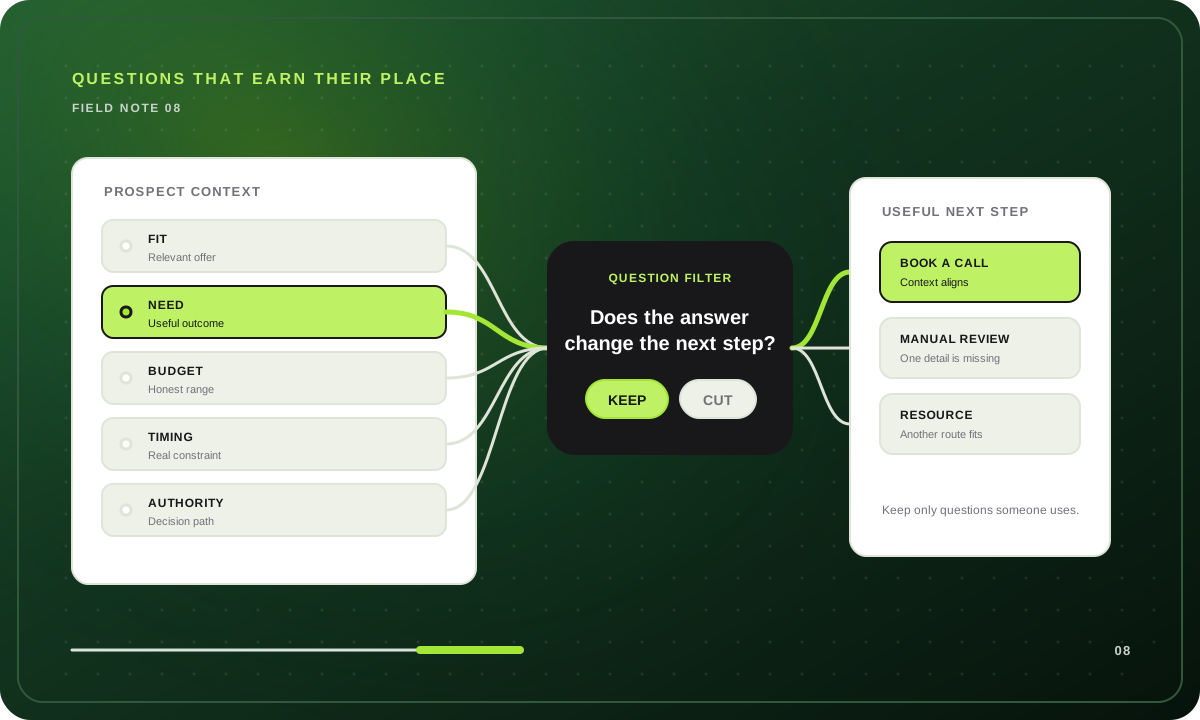
A client questionnaire is a structured set of questions used to understand a prospective client's fit, need, scope, budget, timing, and decision process before committing to the next step. The strongest version is not the longest. It keeps only questions whose answers change review, routing, or preparation for a real conversation.
This guide focuses on questionnaires used before a prospect has been accepted. Delivery access, detailed assets, kickoff logistics, and working preferences belong in onboarding after both sides decide to continue. A first-contact questionnaire should not feel like someone accidentally sent the prospect the entire client portal.
A question earns its place when the answer changes what happens next.
What a client questionnaire should help you decide
A useful questionnaire should make one decision easier. Depending on the business, that decision might be whether to:
- invite the prospect to a discovery or project call;
- review the request manually;
- ask for one missing detail;
- suggest a different service or resource;
- wait until timing or budget changes;
- explain that the request is outside the business's scope.
The questionnaire does not need to close the sale or replace discovery. It needs to collect enough context for the next interaction to be relevant.
This makes a client questionnaire narrower than a full business intake system. Intake can support many kinds of requests and stages. A prospective-client questionnaire specifically helps a service business understand an opportunity before acceptance.
Client questionnaire vs intake vs onboarding
The labels often overlap, so define the stage before choosing questions.
| Form | When it is used | Main decision | Include | Leave for later |
|---|---|---|---|---|
| Contact form | First general message | Who should respond? | Name, contact channel, subject, short message | Qualification and delivery details |
| Prospective client questionnaire | Before acceptance or a first call | Is there enough fit and context for a useful next step? | Need, service fit, outcome, scope, budget, timing, authority | Passwords, system access, complete assets, kickoff logistics |
| Client onboarding questionnaire | After acceptance | What is required to begin delivery? | Stakeholders, access, assets, preferences, working process | Repeating sales-fit questions already answered |
The boundary protects both sides. A prospect should not have to complete delivery paperwork before knowing whether the relationship will continue. A new client should not have to prove the same fit twice.
A copy-ready prospective client questionnaire
The questions below are a starting set, not a requirement to use all of them. Replace service labels, ranges, and response options with the boundaries your business actually uses.
Fit and request type
| Copy-ready question | Why ask it? | Useful answer format | What can the answer change? |
|---|---|---|---|
| What would you like help with? | Connects the request to a service you offer. | Single choice with Other | Service route or useful alternative |
| Which option best describes your organization or role? | Adds only the business context needed to review relevance. | Choice or short text | Audience fit and reviewer assignment |
| Where will the work be delivered or used? | Surfaces a location boundary when one genuinely exists. | Country, region, or short text | Geography route or follow-up |
| How did you hear about us? | Preserves useful referral context without affecting fit. | Choice with optional detail | Attribution or a personalized follow-up |
Do not add an industry, location, or company-size question merely because other forms include one. Keep it only when the answer changes who reviews the inquiry, what can be offered, or how someone prepares.
Need and desired outcome
| Copy-ready question | Why ask it? | Useful answer format | What can the answer change? |
|---|---|---|---|
| What is happening now, and what would you like to be different? | Captures the problem and desired change in the prospect's language. | Paragraph | Review context and first-call agenda |
| What outcome would make this project worthwhile? | Separates the desired result from a deliverable label. | Paragraph or short text | Scope discussion and success criteria |
| What have you already tried? | Reveals existing work, assumptions, and constraints without asking for a full history. | Optional paragraph | Preparation and follow-up questions |
| Why are you exploring this now? | Adds timing context without assuming every project is urgent. | Short text or choice | Readiness route and preparation |
Open questions are useful when the explanation matters. They should not ask the prospect to write a strategy document before the business has decided whether a conversation makes sense.
Scope, budget, and timing
| Copy-ready question | Why ask it? | Useful answer format | What can the answer change? |
|---|---|---|---|
| What needs to be created, changed, or decided? | Gives the reviewer a practical project shape. | Paragraph with examples | Scope review and service route |
| Which investment range has been approved or discussed? | Makes a commercial constraint visible without demanding false precision. | Honest ranges plus Not decided | Fit route or planning resource |
| When would you like the work to begin? | Compares the request with availability and readiness. | Date or range | Call, waitlist, or later follow-up |
| Is there a fixed deadline? If so, what creates it? | Distinguishes a real constraint from a preference. | Optional date and explanation | Feasibility review and preparation |
Publish ranges that reflect the way you actually sell. A range designed only to make the form feel complete does not help the prospect or the reviewer.
Authority and next-step context
| Copy-ready question | Why ask it? | Useful answer format | What can the answer change? |
|---|---|---|---|
| Who will be involved in evaluating or approving this project? | Makes the decision process visible without assuming the respondent has final authority. | Choice with optional detail | Meeting participants and follow-up route |
| What needs to happen before a decision can be made? | Surfaces procurement, stakeholder, or internal timing dependencies. | Short text | Readiness route and next-step expectations |
| Is there anything that could block or materially change the project? | Gives the prospect room to name a constraint the structured questions missed. | Optional paragraph | Manual review or clarification |
| What is the best way to follow up? | Lets the respondent choose a practical contact path. | Email, phone, or another supported option | Follow-up method |
Ask for contact details at the point where the business can explain why they are needed. For many service inquiries, the prospect can first confirm the service and describe the request, then provide an email before submission. A support or account workflow may need identity earlier.
How to choose which questions stay
Run every candidate question through four tests.
Does the answer change the route?
Keep explicit boundaries such as service availability, geography, project range, or timing when different answers lead to different endings or reviewers.
Does the answer improve preparation?
Some questions do not change whether a call happens, but they make that call more useful. The desired outcome, previous attempts, stakeholders, and a fixed deadline can help the reviewer prepare focused follow-ups.
Is this the right stage?
Move delivery access, detailed asset requests, tax details, system credentials, and complete kickoff information into onboarding. The prospective stage should establish whether and how to continue.
Will someone actually use the answer?
Name the person, route, or action that consumes each field. If the answer is never read, does not affect a decision, and is not required for a necessary record, remove the question.
This test is more reliable than choosing an arbitrary form length. A focused questionnaire can contain several conditional paths while showing each prospect only the questions relevant to their request.
How to sequence the questionnaire
A clear sequence reduces context switching and makes the purpose of each section easier to understand.
- Establish relevance. Start with the requested service or inquiry type.
- Understand the need. Ask what is happening and what should be different.
- Shape the request. Collect scope, budget, timing, and important constraints.
- Clarify the decision. Ask who is involved and what must happen before moving forward.
- Collect contact details. Request the minimum information needed to respond.
- Leave optional space. Give the respondent one place for a useful link or detail not covered elsewhere.
- State the next step. Tell the person whether the request will be reviewed, what they can do next, and what they should expect.
Use conditional questions when a detail applies to only one service or answer. A web-design prospect may need to share an existing site URL, while a strategy inquiry may not. Hiding irrelevant fields keeps the common path focused without deleting useful context from a specialist route.
Turn the answers into deliberate routes
The form needs an explicit plan for common combinations of answers.
Use a client intake process flow chart to make the questions, decision points, owners, and endings visible before you build the form.
| Evidence in the questionnaire | Useful destination | What the ending should explain |
|---|---|---|
| Service, scope, range, timing, and decision context align | Project or discovery call | Why the call is the next step and what to prepare |
| The request may fit but one material detail is missing | Manual review or clarification | What will be reviewed or which detail is needed |
| The project is relevant but timing is later | Resource, waitlist, or dated follow-up | What the prospect can do now and when to return |
| The request is outside the published offer | Alternative, referral, or transparent response | The boundary and the most useful available option |
Represent exact boundaries with choices and fixed conditions. Use human review when context is incomplete. Optional AI qualification can help compare several written answers with a policy, but it should not invent missing facts or secretly choose the question order.
The broader guide to pre-qualifying leads before discovery explains how to separate hard rules from contextual judgment.
A complete agency example
Consider a small agency reviewing website, brand, and campaign inquiries.
- The prospect chooses a service.
- The form asks for the current problem and desired outcome.
- Service-specific logic asks only the relevant scope questions.
- The prospect selects an honest investment range and preferred start window.
- The form asks who will approve the work and whether a fixed deadline exists.
- A matching inquiry can continue to a project-call ending.
- An incomplete request can enter manual review.
- An unsupported service can receive a useful alternative instead of a vague confirmation.
This pattern also works for consulting inquiries and freelance project requests. The service labels and ranges change, but the principle stays the same: gather only the evidence needed for a responsible next step.
Common client questionnaire mistakes
Copying a giant question list
A long list can look thorough while collecting information nobody uses. Begin with routes and preparation needs, then select questions. Do not begin with a target number.
Turning the form into unpaid consulting
The prospect should explain the problem and desired outcome, not design the solution or produce a complete internal brief before the relationship starts.
Asking onboarding questions too early
Do not request system access, credentials, complete asset libraries, or detailed delivery preferences before acceptance. Move those fields to a later onboarding flow.
Using vague labels
“Tell us about your project” leaves the expected detail unclear. Separate the current situation, desired outcome, scope, timing, and constraints so each answer has a purpose.
Collecting sensitive information without a clear need
Ask only for information required by the workflow. Review who can access the response, where it will be sent, and whether the prospective stage is the right time to collect it.
Treating AI as the route
AI can interpret open context against written criteria. It should not replace exact conditions, guess missing information, choose the next question, or remove the need for an explicit fallback.
Ending with “We will be in touch”
The final screen should explain what was received, what happens next, and whether the respondent can continue to a call, wait for review, or use another resource.
How the workflow maps to Qualyo
Qualyo stores questions and next steps in a visual route graph. The saved graph determines which question, Logic card, Router, optional Qualifier, or ending comes next.
The same saved questions can be presented in conversational or classic mode. Conversational delivery can personalize the wording of an already selected question, while the route itself remains deterministic.
Use choices and Logic cards for exact service, range, or timing boundaries. Use an optional AI Qualifier only when several earlier written answers need to be compared with owner-written criteria. The form owner selects the automatic outcome used if qualification is unavailable.
Every route can finish with a tailored message or external destination. Notifications and webhooks can pass the saved submission into a later workflow. Qualyo does not provide a native CRM, scheduling platform, payment workflow, contract system, or general file-transfer service.
Start with the working Project Inquiry form template, then replace the example services, ranges, criteria, and endings with the rules your business actually uses.
Frequently asked questions
What is a client questionnaire?
A client questionnaire is a structured set of questions used to understand a prospective or current client's context. Before acceptance, it commonly covers fit, need, scope, budget, timing, and decision authority so the business can choose or prepare the next step.
What should a prospective client questionnaire include?
Include the requested service, current problem, desired outcome, practical scope, investment range, timing, decision process, important constraints, and the minimum contact information needed to respond. Keep a question only when someone uses its answer.
Is a client questionnaire the same as a client intake form?
The terms often overlap. Define them by stage and purpose. In this guide, the prospective-client questionnaire supports review before acceptance. A broader intake form may support other requests, while onboarding collects delivery details after acceptance.
How many questions should a client questionnaire have?
There is no universal number. Keep every question that changes routing, review, preparation, or a necessary record, then remove the rest. Conditional paths can keep the visible experience focused even when the full workflow supports several services.
Should I send the questionnaire before or after a discovery call?
Send it before the call when the answers determine whether the call is relevant or help someone prepare. If every inquiry deserves the same conversation, keep the pre-call form short and collect deeper context during or after discovery.
Should a client questionnaire ask about budget?
Ask when investment range changes fit, service options, or the next step. Use honest ranges, explain why the question matters, and include an undecided option when the business can support an earlier planning conversation.
Does a client questionnaire need AI?
No. Choices, fixed conditions, routers, and tailored endings can define the complete workflow. Optional AI is useful only when open answers need contextual interpretation against written criteria, with an automatic fallback selected in advance.
Start with the decision, then keep only useful questions
Write the possible next steps first. Identify the evidence each step needs, turn that evidence into focused questions, and remove every field that nobody uses.
Browse the agency inquiry workflow, adapt the Project Inquiry form template, or create a free form and draw the route from scratch.