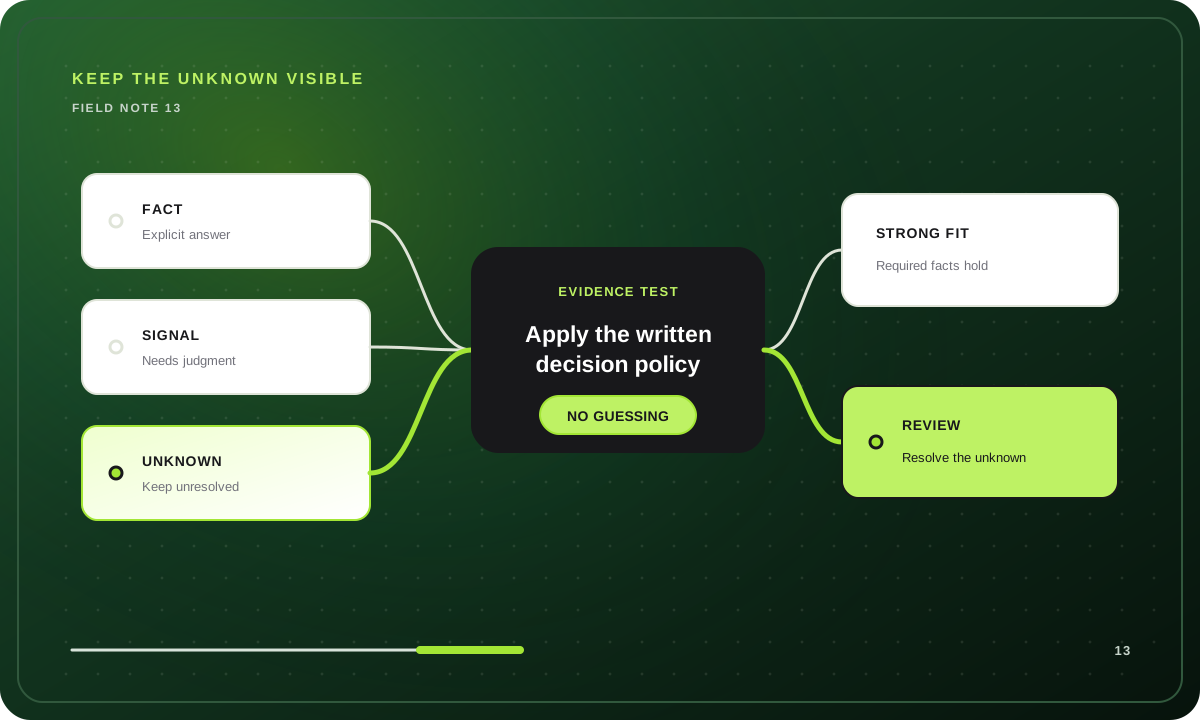
Lead qualification evidence is the information a team can use to decide whether an inbound inquiry fits a specific next step. Treat an explicit answer as a fact, an interpretation as a signal, and missing or contradictory information as unknown. Then apply the decision policy without upgrading a signal into a fact or turning an unknown into a quiet no.
A lead who writes “ASAP” has supplied four capital letters, not a delivery date. The message may signal urgency, but the team still needs a usable timing fact before it promises capacity or opens the calendar.
This guide gives agencies and high-ticket service businesses a facts-versus-signals table, an unknown-state rule, and a worked example they can apply before a sales call.
What counts as lead qualification evidence?
Lead qualification evidence is an answer, observation, or verified record that relates to a criterion in your qualification policy. It has value only when it helps choose a next step.
Use three evidence states:
- Fact: The prospect supplied a specific answer, or the business verified a relevant detail. A fact can support a deterministic rule when its meaning and boundary are exact.
- Signal: The answer suggests fit, readiness, need, or risk but still requires interpretation. A signal can support contextual judgment, not an invented fact.
- Unknown: The required detail is absent, too vague, contradictory, or not safe to infer. Unknown is a real state with its own follow-up or review route.
This page does not redefine sales lead qualification or replace a written policy. It focuses on the evidence that a policy consumes. Use the lead qualification policy template to define criteria, outcomes, fallbacks, and decision ownership.
Facts, signals, and unknowns in lead qualification
The same prospect response can support different evidence states depending on the criterion. “We want to start soon” is a signal of urgency. “Our target start date is November 2” is a timing fact. No answer is unknown.
Use this table as a lead qualification evidence checklist:
| Criterion | Confirmed fact | Contextual signal | Unknown state | Safe treatment |
|---|---|---|---|---|
| Service fit | The prospect selected an active service | The problem description appears related to that service | The request is too broad to map | Ask one clarifying question or send to review |
| Geography | The delivery location is inside the supported region | The company address suggests the right region, but delivery location is unstated | No usable location is available | Keep the location unknown until confirmed |
| Commercial fit | The selected investment range meets a written minimum | The scope language suggests a substantial project | No range or funding context is provided | Do not infer budget from company size or writing style |
| Timing | A requested start date falls inside the delivery window | “Urgent” or “this quarter” suggests timing pressure | No date or planning window is stated | Collect a usable window before applying an exact rule |
| Decision context | The prospect identifies the decision owner and approval path | Senior stakeholders are mentioned without a clear role | No buying process is described | Change call preparation or route to review |
| Need and outcome | The brief connects a current problem to a desired result | The description suggests a relevant need but lacks specificity | The team cannot tell what should change | Use human or optional AI judgment, with a review route |
Unknown-state rule: If a missing fact could change the outcome, keep it unknown. Ask for it, route the inquiry to review, or use the configured fallback. Never substitute a guess merely to complete the decision.
The rule prevents two opposite errors. It stops a promising but incomplete inquiry from being rejected as a poor fit, and it stops persuasive language from bypassing a hard boundary.
Test whether the evidence is strong enough
Evidence is strong enough when it can support the specific decision your team is about to make. Check five properties.
Relevance
Connect every piece of evidence to one written criterion. A company logo, polished website, or long message may feel reassuring, but none proves service fit, budget, timing, or authority unless your policy explicitly says how it matters.
Specificity
Prefer answers with a usable boundary. “This year” may be enough for a nurture decision but not enough to reserve delivery capacity. The required precision should match the consequence of the route.
Source
Distinguish what the prospect stated from what the team or a system inferred. A first-party answer can still be mistaken, but its origin is clear. Enriched or inferred data should remain labeled as such and should not silently override the prospect.
Recency
Use evidence that still describes the opportunity. A budget or start date from an older conversation may need confirmation before it controls a current route.
Consistency
When important answers conflict, preserve the conflict. “Approved budget” and “funding not discussed” cannot both control the same decision without review.
These checks are not a universal score. A single exact disqualifier can outweigh several positive signals, and one decisive unknown can justify review even when the rest of the inquiry looks strong.
Worked example: an agency website inquiry
Imagine a digital agency receives this inquiry:
We need a new marketing site before our November launch. The leadership team is involved, and we are comparing a few partners. We want strategy, design, and development. Budget is still being finalized.
The agency has an active end-to-end website offer, a written minimum engagement, and a delivery window that can support a November launch.
| Evidence | State | What it supports | What it does not prove |
|---|---|---|---|
| “Strategy, design, and development” | Fact | The requested service matches the active offer | The final scope or commercial fit |
| “Before our November launch” | Fact, once the year and date window are confirmed | Timing can be checked against capacity | That stakeholders can approve quickly |
| “Leadership team is involved” | Signal | A decision path may exist | Who owns the decision or how approval works |
| “Comparing a few partners” | Signal | The prospect is evaluating a purchase | That the project is ready to begin |
| “Budget is still being finalized” | Fact about current status | The minimum engagement is unresolved | That the budget is too low |
The useful outcome is needs review, not automatic rejection and not immediate calendar access. The agency can ask for the planned investment range and decision owner. If those answers satisfy the policy, the inquiry can move to a project call. If not, it can receive another useful route.
Notice what did not happen: the agency did not translate a polished brief into an imaginary budget. It used the available evidence, kept the decisive unknown visible, and chose a next step that could resolve it.
How to apply lead qualification evidence
1. Start with outcomes
Name the available routes before collecting evidence. A practical set might include strong fit, needs review, later follow-up, and not qualified for this route. Each label needs a real next action.
2. List the criteria for each outcome
Write the facts that must be true, the contextual judgments that may matter, and the missing information that blocks a confident decision. Keep exact business boundaries separate from preference.
3. Ask only questions that can change the route
For every question, document the criterion it serves and the consequence of each answer. Remove questions that merely make the record look complete.
4. Label evidence states explicitly
Keep facts, signals, and unknowns distinguishable in the decision logic and in any human handoff. A reviewer should be able to see what the prospect said, what was inferred, and what remains unresolved.
5. Match the evaluation method to the evidence
Use deterministic rules for exact service, geography, investment, and date boundaries. Use a person or optional AI for contextual evidence such as problem relevance or scope coherence. AI should evaluate the text against customer-written criteria, not choose the route or invent missing facts. The AI lead qualification forms guide explains the control and fallback model.
6. Test the unknown path
Submit one clear fit, one clear non-fit, one incomplete inquiry, one contradictory case, and one evaluation failure. Confirm that every case reaches a useful outcome and that the fallback behaves as configured.
7. Review decisions against later outcomes
When operators override a route or sales repeatedly discovers the same missing context, inspect the criterion, question, or evidence rule. Do not treat one unusual lead as proof that every boundary should move.
Limitations and edge cases
A fact can still be incorrect
Qualification normally relies on information available at the time. Mark the source and avoid claiming independent verification when none occurred. For high-consequence decisions, require the appropriate human review or verification process.
A signal can be useful without becoming a fact
Open text may reveal a coherent problem, realistic expectations, or conflicting constraints. That context can inform judgment while the underlying budget, location, authority, or timing remains unknown.
More evidence can create more friction
Do not move the entire discovery call into the initial flow. Collect the minimum evidence needed for the next decision, then gather deeper context after the route justifies it.
Different routes need different proof
Offering a general resource may require very little evidence. Reserving founder time, accepting a regulated engagement, or making a capacity commitment may require more exact facts and human review.
The automatic fallback is part of the decision
If contextual evaluation is unavailable, the configured fallback determines what happens. Choose the route that protects both the prospect and the business without pretending the evaluation succeeded.
How this maps to Qualyo
Qualyo lets a customer collect evidence through a conversational or classic qualification flow, apply deterministic Logic and Router behavior, and route each outcome to a configured next step. Exact facts can control deterministic branches.
Optional AI qualification can evaluate open-text evidence against owner-written criteria. The customer selects an automatic qualified or disqualified fallback for provider failure or allowance exhaustion. AI does not choose the route graph, and unknown facts should remain unknown.
Use a manual-review outcome when evidence is incomplete or contradictory. Webhook-based workflows can carry the saved submission and server-derived route outcome into a downstream process. Qualyo is not the CRM or the human reviewer. It operationalizes the customer-defined decision before the next sales step.
Frequently asked questions
What is an example of lead qualification evidence?
A selected service, confirmed delivery location, stated investment range, requested start date, or named decision owner can be evidence. Its state depends on the wording and source. “Budget approved at $25,000” is a fact supplied by the prospect. “This sounds like a large project” is a signal.
What is the difference between a fact and a signal?
A fact is a specific answer or verified detail that can be compared with a criterion. A signal suggests meaning but still needs interpretation. Use exact facts for deterministic boundaries and contextual signals for review or optional AI judgment.
Should missing information disqualify a lead?
Not automatically. If the missing information could change the outcome, keep it unknown and use a clarifying question, review route, or configured fallback. Missing evidence is not proof of poor fit.
Can AI turn a signal into a qualification decision?
AI can interpret contextual evidence against written criteria, but it should not invent a fact or control the route graph. Keep exact requirements deterministic and define what happens when the evaluation is unavailable.
How much evidence should an intake collect?
Collect the minimum evidence needed to choose the next useful step. A higher-consequence route may need more exact facts. A low-risk resource route may need almost none.
Keep the unknown visible
A defensible qualification decision preserves the difference between what you know, what the evidence suggests, and what remains unresolved. Write the policy, collect only route-changing information, and give unknowns a useful next step.
Review the current Qualyo plans and AI allowances, then create a qualification flow that keeps facts, signals, and unknowns explicit.