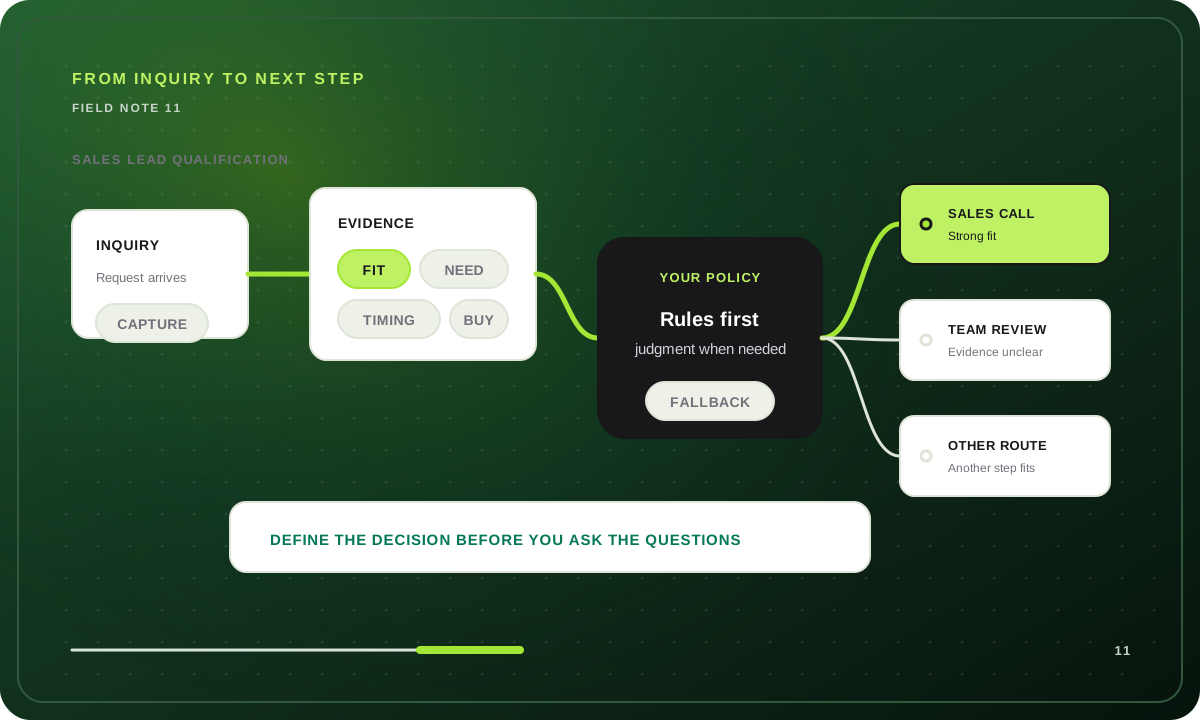
Sales lead qualification is the process of deciding whether an inquiry fits your business, is ready for a sales conversation, or needs a different next step. For a service business, the decision should use criteria you define, evidence the prospect can reasonably provide, and a route that tells both sides what happens next.
A lead is not qualified because someone wrote “looks promising” in the inbox. That is a mood, not an operating rule. A useful qualification process turns the team's judgment into explicit criteria, questions, and outcomes without pretending every uncertain request can be reduced to a score.
This guide gives agencies and high-ticket service businesses a practical model, a copy-ready criteria worksheet, and a worked example for qualifying inbound leads before scarce sales time reaches the calendar.
What is sales lead qualification?
Sales lead qualification evaluates whether a potential customer and a specific opportunity are worth pursuing now. It brings together three questions:
- Can we serve this prospect well? Check audience, geography, service fit, project shape, and delivery constraints.
- Is there a real opportunity to act on? Understand the need, desired outcome, timing, and commercial context.
- What is the most useful next step? Choose a sales call, manual review, later follow-up, alternative service, resource, or clear decline.
The answer is specific to the business. A qualified lead for a brand studio may be a funded rebrand with a defined launch date. A qualified lead for a development agency may be a supported product build with an available decision owner. The labels can match while the criteria differ.
Salesforce and HubSpot both describe qualification as an early evaluation of fit and whether a prospect is worth pursuing. For service businesses, that evaluation should also reflect capacity, economics, and whether the request can move into a productive conversation.
Define a qualified lead from the next step backward
Start with the action your team is willing to take. If “qualified” means calendar access, write down what must be true before a senior seller or founder accepts that meeting. If it means manual review, state what evidence makes the request worth inspecting.
Use this worksheet to turn an informal preference into a usable policy:
| Policy area | Decision to make | Example for a service business | Best treatment |
|---|---|---|---|
| Audience fit | Who can we serve? | B2B company seeking a supported website project | Fixed choices or clear criteria |
| Service fit | Does the request match an active offer? | Strategy and implementation, not staff augmentation | Deterministic rule |
| Commercial fit | Can the engagement work economically? | Investment range meets the minimum for the requested scope | Deterministic rule |
| Timing and capacity | Can both sides act in a useful window? | Desired start matches current delivery capacity | Rule or review route |
| Problem and outcome | Is there a relevant need with a useful goal? | The brief connects the request to a business problem | Human or optional AI judgment |
| Decision context | Can the buying process move forward? | A decision owner or known approval path exists | Question plus review route |
| Missing evidence | What happens when an answer is unclear? | Budget is undecided but the need and timing are credible | Manual review, not invented certainty |
This is a decision policy, not a personality test. Criteria should describe observable facts or explainable judgments. “Serious company” is vague. “Needs one of our active services, can support the minimum engagement, and wants to begin inside our planning window” can be applied and reviewed.
When the worksheet is stable, turn it into a written lead qualification policy with named outcomes, a fallback, and one owner for changes.
Separate fit, readiness, and priority
These ideas overlap, but they are not interchangeable.
Fit asks whether the prospect and request match what you can deliver. Readiness asks whether the prospect can make progress now. Priority helps the team order several opportunities that already deserve attention.
A later start date may reduce urgency without making the lead a poor fit. A large budget cannot rescue a request outside your expertise. A high-priority inquiry can still require review when one decisive fact is missing.
Keeping these concepts separate prevents two common errors:
- rejecting good future opportunities because they are not ready today;
- giving immediate calendar access to urgent requests that the business cannot serve well.
Use the lead fit vs readiness guide for the full three-axis matrix, including when priority should and should not affect the route.
Use distinct outcomes when the next step differs. “Strong fit,” “needs review,” and “not qualified for this route” usually carry more operational meaning than a single pass or fail label. The lead qualification outcomes guide turns those decisions into Book, Review, Nurture, and Decline routes with explicit entry and exit conditions.
Sales lead qualification questions that change the route
Ask only for information someone will use. Every question should change routing, review, preparation, or a necessary record.
| Question | Evidence it collects | Example consequence |
|---|---|---|
| What would you like to change or achieve? | Need and desired outcome | Relevant problem continues; unrelated request receives another route |
| Which service are you considering? | Service fit | Supported service continues; unsupported request gets a clear alternative |
| What is the current situation? | Context and constraints | Specific context supports review; missing context can trigger one follow-up question |
| What investment range are you planning for? | Commercial fit | Matching range continues; an exact minimum can route deterministically |
| When would you like to begin? | Timing and capacity | Feasible timing continues; uncertain timing may go to review or later follow-up |
| Who will be involved in the decision? | Buying process | Known path supports a call; unclear ownership changes preparation or review |
| Is there anything that could prevent the project from moving forward? | Risk and readiness | A material dependency can change the next step before the call |
Do not ask a prospect to complete the entire discovery call in writing. Qualification should collect the minimum context needed for a sound next action. Discovery can then explore the problem with follow-up questions and room for correction.
For a detailed pre-call sequence, use the guide to pre-qualifying leads before discovery.
Use rules for certainty and judgment for context
Some criteria have exact answers. If the business only serves certain locations, has a clear minimum engagement, or does not offer a requested service, express that boundary as a deterministic rule.
Other criteria depend on several open answers. A project brief might reveal a strong need, realistic expectations, and useful timing without using the exact words in a checklist. That case can go to a person for review or to optional AI qualification against written criteria.
Keep the distinction explicit:
- Deterministic rules: exact service, geography, investment band, date range, or required choice.
- Contextual judgment: problem relevance, scope coherence, expectation fit, or uncertainty across several written answers.
- Fallback: the preselected route used when contextual evaluation cannot run or does not have enough evidence.
AI should interpret the evidence it receives. It should not invent a missing budget, decide what your ideal customer means, or redraw the route. The AI lead qualification guide covers that narrower implementation in detail.
Worked example: an agency project inquiry
Consider an agency that sells strategy and implementation projects. This example is illustrative, not a universal definition of a good lead.
The agency writes this policy:
Offer a project call when the request matches an active service, clears the minimum engagement, fits the current planning window, and describes a problem the agency can credibly solve. Send unclear but plausible requests to team review. Give unsupported services and below-minimum projects a useful alternative.
The route can then apply the policy in layers:
- Capture: ask for the service, desired outcome, current situation, investment range, timing, and decision context.
- Check hard boundaries: route unsupported services and below-minimum ranges without asking a model to interpret them.
- Evaluate context: review whether the brief describes a relevant problem, feasible scope, and workable expectations.
- Route the outcome: offer a project call, send the inquiry to team review, or provide a relevant alternative.
- Record the reason: retain enough context for the next person to understand why the route was selected.
Three sample inquiries show why the layers matter:
| Inquiry | Evidence | Outcome | Reason |
|---|---|---|---|
| Supported service, viable range, clear goal, feasible timing | Hard rules pass and context aligns | Strong fit, offer a project call | The call can focus on the opportunity instead of basic eligibility |
| Supported service and range, but a key dependency is unclear | Hard rules pass and context is incomplete | Needs review | A person can resolve the ambiguity before calendar access |
| Unsupported service or range below the defined minimum | Exact boundary does not match | Alternative route | The prospect receives an honest next step without an unnecessary sales call |
The Agency Project Qualification Flow provides a ready-to-customize version of this route. Replace every sample service, threshold, criterion, and destination with the reality of your business.
Build a repeatable qualification process
1. List the possible outcomes
Name every useful destination before writing questions. Include review and alternative routes, not only the preferred booking path.
2. Write the criteria for each outcome
Use observable facts for hard boundaries. Write short evaluation instructions for contextual fit. Define how uncertainty should be handled.
3. Collect only decision-changing evidence
Map each criterion to a question or an existing source of reliable context. Remove questions that do not change a route or improve preparation.
4. Implement the route in layers
Apply exact rules first. Use human or optional AI judgment only where open context matters. Make every fallback and ending visible.
5. Test edge cases and review outcomes
Test a clear fit, a clear non-fit, a promising but incomplete request, contradictory answers, and any evaluation failure. Review whether the selected route and message remain useful for the prospect.
Update the policy when your offers, economics, capacity, or sales process change. Qualification is a maintained operating decision, not a one-time form project.
Common sales lead qualification mistakes
Copying a framework without adapting it
BANT, MEDDIC, and other frameworks can provide prompts, but they do not define your customer, delivery constraints, or acceptable opportunity. Use a framework to notice missing considerations, then write criteria for your actual business.
Treating lead scoring as the decision
A score ranks signals according to a model. Qualification decides whether an opportunity meets the criteria for a next step. A high score should not override a hard disqualifier or conceal missing evidence. Use the lead qualification evidence guide to separate confirmed facts, contextual signals, and unknowns before applying the policy.
Using one outcome for every uncertain lead
Uncertainty is not the same as poor fit. A manual review route prevents the system from forcing an answer when the evidence is incomplete.
Asking too much too early
A long questionnaire can move discovery work onto the prospect before the business has shown relevance. Keep the initial flow focused, then collect deeper context after the route justifies it.
Ending a non-fit route with a dead end
A request that does not qualify for a call may still deserve a useful resource, a better-fit service, a later follow-up path, or a clear explanation. The outcome should protect sales time without making the prospect decode what happened.
How sales lead qualification maps to Qualyo
Qualyo lets a business collect inbound context, apply its own qualification policy, and route each result in a visual graph. Conversational and classic presentations use the same saved questions, validation, and routes.
Use Logic and Router behavior for exact conditions. Add optional AI qualification when written answers need contextual interpretation against owner-written criteria. The saved graph remains authoritative, and the form owner selects the automatic qualified or not-qualified fallback used when AI cannot run.
Each route can finish with a tailored ending or an external link. Completed submissions can separately trigger configured notifications and webhook-based workflows. Qualyo is not a CRM or scheduling platform. It is the qualification layer that turns an inbound request into a controlled next step.
See the agency lead qualification use case for audience-specific guidance.
Frequently asked questions
What is a qualified sales lead?
A qualified sales lead is a prospect and opportunity that meet the business's criteria for a defined sales action. The definition should name the relevant fit, need, timing, commercial, and decision conditions rather than rely on a generic label.
Is sales lead qualification the same as lead scoring?
No. Lead scoring assigns points or ranks signals. Qualification applies criteria to decide whether a lead should move to a particular next step. A team may use both, but a score should not silently replace hard boundaries or human review.
When should a service business qualify an inbound lead?
Collect the minimum decision-changing context before offering scarce sales time. Continue qualification during discovery as new evidence appears, especially for complex or high-value work.
Can sales lead qualification be fully automated?
Exact rules can be automated, and contextual answers can be evaluated by a person or optional AI. Unclear, sensitive, unusual, or high-consequence decisions still need an appropriate review path. Every automated system also needs a useful fallback.
How many qualification criteria should we use?
Use the smallest set that reliably changes the next step. A criterion belongs when it protects delivery fit, commercial viability, readiness, or the quality of the sales conversation. Remove criteria that nobody acts on.
Turn the definition into a route
Write the outcomes first, define what evidence each one needs, and make uncertainty a deliberate path. Then build the shortest qualification flow that can apply those decisions consistently.
Start with the Agency Project Qualification Flow, adapt the criteria to your business, or create a qualification flow from scratch.
Sources
External references used for this guide. Product details are checked against the current Qualyo implementation.
- What Is Lead Qualification and How Does It Work?: SalesforceAccessed September 7, 2026
- Lead qualification: Gauging whether a lead aligns with your offering: HubSpotAccessed September 7, 2026