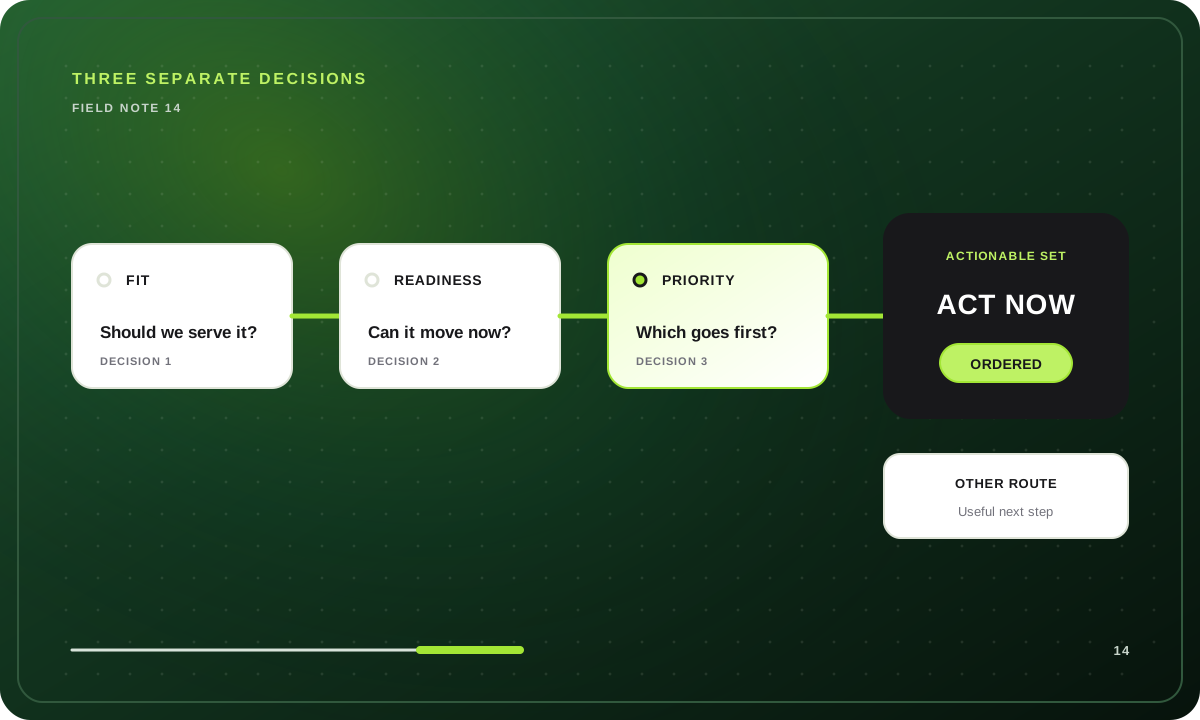
Lead fit asks whether an inquiry matches what your business can serve. Readiness asks whether the prospect and opportunity can move now. Priority decides which already-actionable opportunity deserves attention first. Evaluate them separately and in that order so urgency cannot rescue poor fit and low urgency cannot erase a valuable future opportunity.
If every lead is high priority, the label has become office decor. A useful system gives fit, readiness, and priority different definitions, evidence, and consequences.
This guide gives agencies and high-ticket service businesses a three-axis decision matrix, route examples, and an implementation sequence they can use before a sales call.
Lead fit vs readiness: the practical difference
Fit and readiness answer different questions.
- Lead fit: Can the business serve this prospect and request well under its current offer, constraints, and economics?
- Lead readiness: Can the opportunity make useful progress now, based on timing, problem clarity, decision context, and other customer-defined conditions?
- Lead priority: Among opportunities that deserve action, which should the team handle first with its available time and capacity?
A prospect can be a strong fit and not ready. A prospect can be ready to buy and still be a poor fit for the service. Two leads can both be strong fits and ready now, yet one may need faster attention because its deadline is closer or the team has limited specialist capacity.
This page does not redefine sales lead qualification, prescribe a universal score, or decide which evidence is trustworthy. Use the lead qualification evidence guide to separate confirmed facts, contextual signals, and unknowns before applying these three decisions.
Compare fit, readiness, and priority
| Decision | Core question | Typical evidence | Time behavior | What it should change |
|---|---|---|---|---|
| Fit | Should we serve this request? | Audience, service, geography, scope, commercial boundaries, delivery constraints | Often stable for the life of the inquiry, but can change when the offer or request changes | Eligibility for a preferred route, review, or another route |
| Readiness | Can this opportunity progress now? | Problem clarity, timing, available investment, decision path, dependencies, willingness to take the next step | Time-sensitive and likely to change | Act now, follow up later, collect missing context, or review |
| Priority | Which actionable opportunity goes first? | Deadline, consequence of delay, capacity match, service commitments, and other written team priorities | Relative to the current queue and capacity | Response order, owner, or service level |
The sequence matters. Fit protects the business from accepting work it should not do. Readiness protects sales time from moving too early. Priority protects response capacity when several suitable opportunities compete for attention.
Do not blend the axes into one adjective such as “hot.” That label cannot tell an operator whether the lead is unsuitable, early, incomplete, or simply behind another good opportunity in the queue.
Use this three-axis decision matrix
Define each axis with observable criteria, then choose the next step from the combination. The labels below are examples, not a universal qualification model.
| Fit | Readiness | Priority | Example interpretation | Useful route |
|---|---|---|---|---|
| Strong | Ready | High | The request matches the offer, can move now, and has a written reason for faster attention | Route to the appropriate sales owner promptly |
| Strong | Ready | Normal | The opportunity is actionable but has no reason to bypass other accepted work | Route to the standard sales queue |
| Strong | Not ready | Not assigned yet | The opportunity could be valuable later, but a timing or decision condition is not met | Offer a later follow-up or useful resource |
| Strong | Unknown | Not assigned yet | The fit looks promising, but decisive readiness evidence is missing or contradictory | Ask one clarifying question or send to review |
| Weak | Ready | Not applicable | The prospect wants to move, but the request falls outside a firm boundary | Provide another useful route without using urgency as an exception |
| Mixed | Ready | Not assigned yet | One fit criterion requires judgment before the team accepts the opportunity | Send to review before ordering it against accepted leads |
The matrix follows one rule: priority applies after the opportunity clears the fit and readiness decision for the intended action. An urgent request outside your service area does not become a high-priority sales lead. It becomes a high-urgency request for a different route.
Define each axis without inventing a score
Define fit from the offer and constraints
Start with the work the business is prepared to deliver. Useful fit criteria can include audience, active service, geography, project type, commercial minimum, delivery model, and exclusions.
Keep exact boundaries deterministic. If the agency does not offer staff augmentation, a request for one embedded developer should not pass because the company is attractive or the deadline is urgent.
Use judgment only where the criterion is genuinely contextual. A complex brief may require a person or optional AI to decide whether the problem matches the team's expertise. Preserve a review route when the answer is uncertain.
Define readiness from the next action
Readiness is not enthusiasm. It describes whether the prospect can take the next useful step now.
For a project call, the team might need a relevant problem, a usable planning window, investment context, and a decision path. For a low-risk resource, readiness may require almost nothing. Match the proof to the consequence of the route.
Write what would change a not-ready decision. A future launch date, approved investment, completed internal planning, or identified decision owner can make the same lead ready later without changing fit.
Define priority from the accepted queue
Priority orders opportunities that already deserve action. It is not a second qualification test and should not quietly replace one.
Use factors the team can explain, such as an approaching deadline, an existing service commitment, a scarce specialist's availability, or the consequence of delay. Keep the rule specific enough that two operators would make the same ordering decision from the same facts.
Do not let deal size automatically dominate. A larger opportunity may require more review, have a weaker delivery match, or be less ready than a smaller request. The customer decides which factors matter and how conflicts are resolved.
Worked example: three agency inquiries
Imagine a web agency receives three inquiries on the same morning.
Inquiry A: urgent but outside the offer
The prospect needs a developer embedded in its team next week. The agency sells complete strategy, design, and build engagements, not staff augmentation.
- Fit: weak because the delivery model falls outside the active offer.
- Readiness: high because the prospect can act immediately.
- Priority: not applicable to the agency's sales queue.
- Route: explain the boundary and provide an appropriate alternative if one exists.
Urgency changes how quickly the agency should respond, not whether the request fits.
Inquiry B: strong fit with a later planning window
The prospect wants the agency's full website service, has a relevant business problem, and expects internal approval next quarter.
- Fit: strong.
- Readiness: not yet ready for the protected project-call route.
- Priority: not assigned until the opportunity becomes actionable.
- Route: offer a useful planning resource and a defined later follow-up.
The lead remains valuable. Its current route reflects timing, not rejection.
Inquiry C: strong fit and ready now
The request matches the offer, the planned investment clears the written minimum, the decision owner is involved, and the launch window fits capacity.
- Fit: strong.
- Readiness: ready.
- Priority: compare against other accepted opportunities using the team's deadline and capacity rules.
- Route: standard or accelerated project-call path, depending on that comparison.
The agency can explain every outcome without hiding behind one score. Each inquiry receives the next step supported by its actual state.
How to implement the three decisions
1. Name the protected action
Choose the step that requires qualification, such as calendar access, proposal review, or assignment to a specialist. Fit and readiness must be defined for that action, not for an abstract idea of a good lead.
2. Write fit boundaries
List hard disqualifiers, exact requirements, and contextual fit criteria. Connect each item to evidence you can collect or review.
3. Write readiness conditions
State what must be true for progress now and what event can change a not-ready result later. Keep missing information distinct from a confirmed failure.
4. Create routes before priority rules
Define strong fit, needs review, later path, and other useful outcomes. The lead qualification policy template provides a compact operating contract for the criteria, evidence, outcomes, fallback, and ownership.
5. Apply priority only inside the actionable set
Choose the few factors that change response order among accepted leads. Document ties, exceptions, and who owns the queue when capacity is constrained.
6. Test combinations, not only ideal leads
Test strong fit and ready, strong fit and not ready, weak fit and urgent, promising but unknown, conflicting answers, and an evaluation failure. Confirm that the resulting route and message remain useful.
7. Review changes over time
Fit rules should change when the offer, economics, audience, or delivery constraints change. Readiness should be reassessed when new evidence arrives. Priority should update with the active queue and capacity.
Common mistakes and edge cases
Treating urgency as readiness
A short deadline shows timing pressure. It does not prove budget, decision access, service fit, or the ability to start. Collect the evidence required for the intended route.
Treating not ready as not qualified forever
Record the missing condition and the event that should trigger reconsideration. Otherwise, a temporary state becomes a permanent label without evidence.
Prioritizing before resolving unknowns
A promising inquiry with a decisive unknown belongs in review, not at the top of an accepted queue. Resolve the missing fact before comparing it with ready opportunities.
Using a universal definition of strong fit
Every business has different offers, constraints, economics, and risk. Copy the structure of the matrix, then write criteria for the actual service and route.
Forcing every case into automatic acceptance or rejection
Contradictory answers, unusual opportunities, sensitive decisions, and evaluation failures need an explicit review or fallback path. Uncertainty is an operating state, not permission to guess.
How this maps to Qualyo
Qualyo lets customers collect route-changing evidence through conversational or classic qualification flows. Deterministic Logic and Router behavior can enforce exact fit and readiness boundaries and send each outcome to the configured next step.
Optional AI qualification can interpret open-text evidence against owner-written criteria. It does not choose the route graph. The owner selects the automatic qualified or disqualified fallback used when the evaluation is unavailable. The AI lead qualification forms guide covers those controls in more detail.
Priority can influence a customer's configured routing policy, but Qualyo is not a CRM queue or a universal scoring system. The customer defines what fit, readiness, and priority mean, which evidence each decision uses, and what every route should do.
Frequently asked questions
What is the main difference between lead fit and lead readiness?
Fit asks whether the prospect and request match what the business can serve. Readiness asks whether the opportunity can make useful progress now. A strong-fit lead can be unready, and a ready buyer can still be a poor fit.
Is urgency the same as readiness?
No. Urgency is one timing signal. Readiness may also depend on problem clarity, investment context, decision access, dependencies, and the specific next step the business is protecting.
When should lead priority be assigned?
Assign priority after the lead clears the fit and readiness decision for the intended action. Use priority to order accepted opportunities, not to rescue a poor-fit lead or hide an unresolved case.
Should fit, readiness, and priority use one score?
Not by default. Separate states make the route easier to explain and test. A score can support ordering, but it should not override a hard disqualifier, conceal missing evidence, or replace human review where judgment is required.
Can lead readiness change?
Yes. Readiness is time-sensitive. A later approval, clearer timeline, available investment, or identified decision owner can change the next step without changing the prospect's underlying fit.
Keep the decisions separate
Fit determines whether the opportunity belongs. Readiness determines whether it can move now. Priority determines which accepted opportunity goes first. Separate the evidence and rules for each, then give every combination a useful next step.
Review the current Qualyo plans and AI allowances, then create a qualification flow that keeps fit, readiness, and priority distinct.