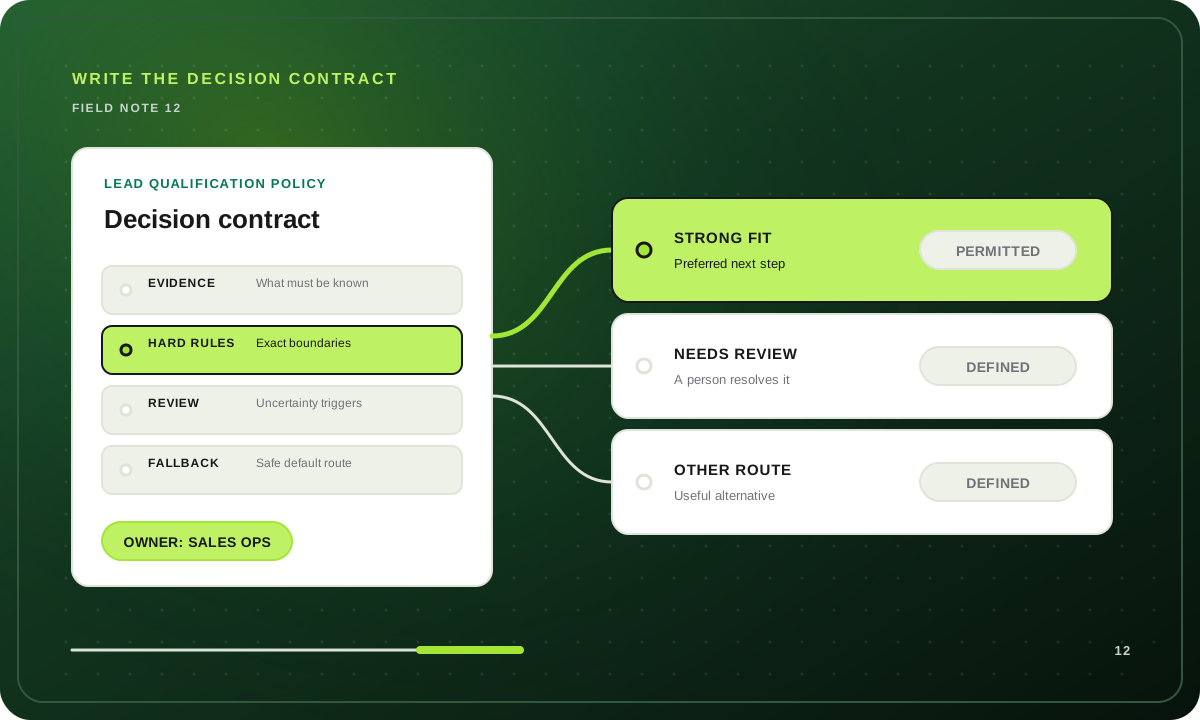
A lead qualification policy is a written operating agreement that tells your team what evidence to collect, which rules decide clear cases, when judgment is allowed, and what next step belongs to each outcome. It turns “we know a good lead when we see one” into a decision that people, forms, and automation can apply and review.
If the policy lives only in the founder's head, its change log is mostly eyebrows. A useful policy names the decision owner, the boundaries, the missing-evidence route, and the moment the policy should be reviewed.
This guide gives agencies and high-ticket service businesses a copy-ready lead qualification policy template, a worked example, and a practical way to turn the document into a controlled qualification flow.
What is a lead qualification policy?
A lead qualification policy documents how an inbound inquiry becomes one of several defined outcomes. It is narrower than the full sales lead qualification process: the process covers questions, evaluation, routing, and review, while the policy is the decision contract that those activities apply.
The policy should answer seven operational questions:
- What decision are we making? Name the action being controlled, such as access to a project call.
- What evidence is required? List only the facts and context needed for that decision.
- Which conditions are hard rules? Identify exact boundaries that should produce the same result every time.
- Where is judgment allowed? Describe the contextual signals a person or optional AI may interpret.
- What outcomes are permitted? Give every route a useful, specific meaning.
- What happens when evidence or evaluation is unavailable? Choose a safe fallback before launch.
- Who owns changes? Name the person responsible for approving and reviewing the policy.
Without these answers, a qualification form can collect plenty of information while still leaving the real decision undefined.
Copy-ready lead qualification policy template
Copy this policy card into your operating notes. Replace every example and placeholder with your own business reality.
Policy name: [Route or offer being qualified]
Decision: Decide whether an inbound inquiry should receive [preferred next step], [manual review], or [alternative route].
Decision owner: [Role accountable for approving this policy]
Applies to: [Lead source, audience, offer, geography, or inquiry type]
Required evidence: [The minimum facts and context needed to make the decision]
Hard qualification rules: [Observable conditions that must be true]
Hard disqualifiers: [Observable conditions that send the inquiry to another route]
Contextual signals: [Open-text evidence that can strengthen, weaken, or complicate fit]
Review triggers: [Missing, contradictory, unusual, sensitive, or high-value cases a person should inspect]
Allowed outcomes: [Outcome name, respondent message, internal owner, and next action for each route]
Automatic fallback: [Route used if contextual evaluation cannot run]
Evidence retained: [Answers and decision reasons the next owner needs]
Review cadence: [Date or business event that triggers a policy review]
The template is deliberately short. A policy should be detailed enough to produce consistent action, but compact enough that an operator can read it before building or changing the flow.
Write the policy from the outcome backward
Start with the scarce or consequential action you are protecting. For many service businesses, that is calendar access. For another team, it may be a proposal review, a partner introduction, or assignment to a specialist.
Then define the alternatives. A useful policy rarely has only “qualified” and “rejected.” Consider at least these routes:
| Outcome | Meaning | Respondent next step | Internal ownership |
|---|---|---|---|
| Strong fit | Required evidence is present and the policy supports the preferred action | Offer the relevant call or handoff | Named sales or service owner |
| Needs review | The request may fit, but decisive evidence is missing, unusual, or contradictory | Confirm review and set an expectation | Named review queue or person |
| Not ready | The request could fit later, but the timing or decision context is incomplete | Give a useful resource or later path | Nurture owner, if one exists |
| Other route | A clear boundary does not match this offer | Explain the alternative honestly | Owner of the alternative, or no internal action |
The lead fit vs readiness guide explains how to keep eligibility, ability to act now, and queue priority from collapsing into one outcome label.
Use the lead qualification outcomes guide to give each permitted route its own entry evidence, owner, respondent promise, and exit condition.
Writing the outcomes first prevents questions from becoming a wish list. If an answer does not change an outcome, improve preparation, or support a necessary record, it probably does not belong in the initial qualification flow.
Separate hard rules from contextual evidence
A lead qualification policy becomes easier to operate when exact facts and contextual judgment are handled differently.
Use hard rules for facts you can state precisely. Examples include an active service, supported location, minimum engagement range, required certification, or a date inside a known delivery window. The same answer should produce the same result.
Use contextual evaluation for meaning across answers. Examples include whether the problem fits your expertise, whether expectations are coherent, or whether the request describes a plausible business outcome. A person can review this evidence. Optional AI can also interpret it against written criteria, provided missing facts remain missing and the route stays under owner control.
Use review for unresolved cases. Contradictory answers, important unknowns, unusual opportunities, and sensitive decisions should not be forced into a confident label. “Needs review” is an operating outcome, not a failure of the policy. The lead qualification evidence guide provides a facts-versus-signals table for deciding when evidence is strong enough to apply the policy.
This separation also makes testing clearer. Hard rules need boundary tests. Contextual instructions need representative examples. The fallback needs a deliberate test where the evaluation is unavailable.
Worked example: agency project qualification policy
Imagine a digital agency qualifying website project inquiries before offering a strategy call. Its policy could read like this:
Decision: Offer a strategy call, send the inquiry to team review, or provide another route.
Applies to: Inbound requests for the agency's active strategy and implementation services.
Required evidence: Requested service, desired outcome, current situation, investment range, preferred start window, and decision context.
Hard qualification rules: The request matches an active service, the selected investment range supports the minimum engagement, and the requested location or delivery mode is supported.
Hard disqualifiers: The request is for an unsupported service or falls outside a boundary the agency can state exactly.
Contextual signals: The brief describes a relevant problem, a plausible outcome, workable expectations, and a reason the work matters now.
Review triggers: The investment is undecided, the brief conflicts with a selected answer, a delivery dependency is unresolved, or the opportunity is unusual enough to merit a person.
Outcomes: Strong fit receives the strategy-call route. Unclear but plausible requests receive a review confirmation. Unsupported requests receive a relevant alternative or a clear close.
Fallback: If contextual evaluation is unavailable, send the inquiry to team review rather than offering calendar access automatically.
Owner: The person responsible for agency sales operations reviews the policy when offers, minimum engagements, or capacity windows change.
This example is not a universal definition of a qualified lead. Its value is the structure: evidence, rules, judgment, outcomes, fallback, and ownership are visible. The Agency Project Qualification Flow provides a ready-to-customize implementation pattern, but its sample criteria and destinations still need to be replaced with your policy.
Turn the written policy into a qualification flow
Use the policy as the build specification for the form and route:
- Create the outcomes. Add the preferred, review, not-ready, and alternative destinations that your policy permits.
- Map evidence to questions. Ask the minimum questions needed to apply the hard rules and contextual criteria.
- Apply exact conditions first. Use deterministic logic for facts the policy defines precisely.
- Add contextual evaluation only where needed. Send open-text evidence to a person or optional AI with the relevant policy language.
- Connect the fallback. Confirm where the inquiry goes if evidence is missing or an evaluation cannot run.
- Preserve decision context. Keep the answers and concise reason the next owner needs for follow-up.
- Test each route. Use a clear fit, clear non-fit, incomplete request, contradictory request, and evaluation failure.
The route should make the policy observable. A teammate should be able to look at the saved flow and explain which evidence produces each next step.
Maintain the policy as the business changes
A lead qualification policy is not permanent. Review it when an offer changes, pricing or minimum engagement changes, capacity shifts, a new audience or territory opens, or operators repeatedly override the same decision.
Keep policy changes small and attributable:
- record what changed and why;
- identify which routes and questions are affected;
- retest the boundary and fallback cases;
- review recent decisions for unintended effects;
- give one owner authority to approve the new version.
Do not update the policy merely to make a dashboard look better. A higher qualification rate can mean the policy improved, the audience improved, or the boundaries became too loose. Review the underlying decisions and outcomes before changing the rule.
How the policy maps to Qualyo
Qualyo lets a business collect inbound context, apply customer-defined qualification rules, and connect each result to a visible next step. Conversational and classic presentations use the same saved questions, validation, and routes.
Use Logic and Router behavior for exact conditions. Where several written answers need contextual interpretation, use a person or optional AI qualification against the policy. The saved graph remains authoritative, and the form owner chooses the automatic qualified or not-qualified fallback used if AI cannot run.
Each route can end with a tailored message or external link. Completed submissions can separately trigger configured notifications and webhook workflows. Qualyo is not a CRM or scheduling platform. It is the qualification layer between inbound evidence and the next action your policy allows.
For an audience-specific view, see lead qualification for agencies.
Frequently asked questions
What should a lead qualification policy include?
Include the decision, scope, required evidence, hard rules, disqualifiers, contextual signals, review triggers, permitted outcomes, automatic fallback, evidence to retain, decision owner, and review cadence.
Who should own the lead qualification policy?
Choose one role with authority over the sales action being controlled. Contributors can include sales, marketing, delivery, and operations, but one owner should approve changes and resolve conflicts.
Is a lead qualification policy the same as a scoring model?
No. A policy defines the evidence, boundaries, outcomes, and ownership for a decision. A scoring model ranks or totals selected signals. A score can support a policy, but it should not hide hard disqualifiers, missing evidence, or required human review.
How often should the policy be reviewed?
Set a regular review that fits the pace of the business, and review it sooner when offers, economics, capacity, audiences, or repeated operator overrides change. Business events are usually more meaningful triggers than an arbitrary date alone.
Can AI apply a lead qualification policy?
AI can help interpret open-text evidence against written criteria. Keep exact boundaries deterministic, require unknown facts to remain unknown, preserve an appropriate human-review route, and select a useful automatic fallback before publication. The AI lead qualification forms guide covers those controls in detail.
Put the policy to work
Copy the policy card, replace the placeholders with decisions your team can defend, and test every outcome before opening the route to inbound traffic.
Start with the Agency Project Qualification Flow, or create a qualification flow from your own written policy.
Sources
External references used for this guide. Product details are checked against the current Qualyo implementation.
- What Is Lead Qualification and How Does It Work?: SalesforceAccessed September 8, 2026
- Lead qualification: Gauging whether a lead aligns with your offering: HubSpotAccessed September 8, 2026